Thursday, 24 September 2020


A simple conversation 


A) मह्यं  मम यानं विपरीतं स्थापनं रोचते। mahyaM mama yAnaM viparItaM sthApanaM rocate( I like to reverse park my car)

B) किमर्थम्? kimartham (Why is that so?)

A) कदा  बहिर्गमनम्  इचामि तदा सरलतरं भवति।

kadA bahirgamanam icAmi tadA saralataraM bhavati.

(When I want to go out it's easier)

B)अस्तु।उच्चितम् | astu| uccitam| Ok, that's right.


Friday, 4 September 2020


Conversational Sanskrit.

One often neglected aspect of Sanskrit is its conversational aspect.

It's very much conversational if one is patient enough to study it.

The problem is most people aren't patient enough to learn the grammar and vocabulary and link it too fast to religion and miss the beauty of the language.

To learn Sanskrit effectively as to speak it, firstly drop all thoughts of getting "spiritually high" by learning it.

Sanskrit is very much a usable day to day language and when we place it too high on a pedestal we neglect its functional aspect and it remains unused and totally untapped.

It's like how everyone hangs a picture of God on their walls but do not think about Him at all.

I wrote this simple conversation which anyone can relate too to show its functional aspect. It would just reveal to us how much its so user friendly if we only drop its "spiritual tag" and actually use it.


नमस्ते। namaste (Hello)

नमस्ते | namaste(Hello)

किं करोषि ? kiM karoSi? (what are you doing?)

अहम्? aham? (me?)

आम्, आम् त्वमेव।  aam aam, tvameva(Yes! Yes! it's you I am referring to)

किमपि न करोमि। kimapi na karomi(not doing anything)

किमार्थम्? kimArtham? (why?)

विरामः।virAmaH (holiday)

अस्तु।कुत्र असि  इदानीम्? astu. kutra asi idAnIm( ok, where are you now?)

गृहे एव। किमार्थम्?  आगच्छसि  वा? gRhe eva. kimArtham? Agacchasi vA?(at home only, why? are you coming?)

अधुना न शक्नोमि किन्तु  सयङ्काले आगमिष्यामि। adhunA na shaknomi kintu sayankAle AgamiSyAmi.(not able to now but will come in the evening)

अस्तु।पुनर्मिलामः। astu.punarmilAmaH( ok, see you)

पुनर्मिलामः।punarmilAmah(see you)


Thursday, 20 August 2020


So what? It's no big deal!


Let's take a look at this simple conversation to understand the usage of the phrase "So what? It's no big deal"


अद्य सः पठति|  adya saH paThati ( Today he is reading)

तेन किम्? tena kim? (So what?)

अहम् अपि पठामि | aham api paThAmi ( I am also reading)

इदं महाकार्यं नास्ति |  idaM mahAkAryaM nAsti (This is no big deal)

Monday, 10 August 2020


व्यञ्जन (Vyanjana) the story of  Consonants and Curry.


In Sanskrit the word व्यञ्जन (Vyanjana) can mean:

1)Consonant

2)Curry.

It might sound strange but there is a basis for this.

Firstly what is a consonant?

A consonant is an alphabet that can only be sounded with the help of a vowel.

For eg क (ka) is a consonant.

 क (ka)  = क् (k) + अ(a)

क(ka) can only be articulated with the help of the vowel अ(a)


In Sanskrit a vowel is called स्वर:(svara)  which is short for 

स्वयं राजते इति स्वर: svayaM rAjate iti svaraH which means that " A vowel is that which is self established"

In other words the vowel does not need the aid of any alphabet to articulate itself as it is the basis of phonetics.

 Now coming to a Consonant व्यञ्जन (Vyanjana), as it was written earlier that a consonant can not be articulated without the help of a vowel.

Therefore a Consonant is not a main alphabet.

It can't stand without a vowel.

Ok, now lets get to the story of the other व्यञ्जन (Vyanjana), Curry.

Here it gets interesting.

As we know that we have to eat curry with the main dish like rice or bread.

The curry therefore is a side dish and the main basis of the meal is either rice or bread.

Therefore in this context a curry is called व्यञ्जन (Vyanjana) because its not the main dish and can not be eaten on its own without rice or bread.

To recap : A  Consonant व्यञ्जन (Vyanjana) can not be articulated without the main alphabets(The Vowels) 

and a Curry व्यञ्जन (Vyanjana) can not be eaten without the main dish of either rice or bread.

Strange but true..both consonants and curries are just side dishes.


Thursday, 30 July 2020

रासक्रीडा (The Divine Essence in Play)

Today we would touch upon the word रासक्रीडा (rAsakriDA) and its deeper meaning.
It's a word so wrongly understood that lead humans to give it an erotic shade.

We find the word  रासक्रीडा (rAsakriDA) in the Srimad Bhagavata Purana where Lord Krishna as a child manifested Himself into many and danced with the devoted pure hearted Gopikas.

But sadly it is always pictured as if Lord Krishna was flirting with them!

So what is the truth? The truth lies in the word  रासक्रीडा (rAsakriDA).


Meaning:

रास (rAsa) = Essence
क्रीडा (krIDA) = Play.

Lord Krishna is Paramatma and the Gopikas represent Jeevatma.
So the whole  रासक्रीडा (rAsakriDA) is the Divine Essence in Play where the "Pure hearted Lovers of God" drown in His Divine Essence so beautifully captured as a dance of the Lover(Jeevatama) and The Beloved (Paramatma).
This is the actual understanding of the रासक्रीडा (rAsakriDA).

Those of you who are familiar with the works of Jalalludin Rumi  would understand the Dance of Lover and the Beloved as he had said :

"The Beloved has permeated every cell of my body Of myself there remains only a name, everything else is Him."

Saturday, 11 July 2020


Decoding of the Gayatri Mantra.

The Gayatri Mantra is a mantra from the Rigveda.
Most of us are familiar with it as in:
ॐ भूर्भुवः स्वः
तत्सवितुर्वरेण्यं
भर्गो देवस्य धीमहि
धियो यो नः प्रचोदयात् ॥

Om bhur bhuvaH svaH
tat savitur vareNyaM
bhargo devasya dhImahi
dhiyo yo naH pracodayAt

However in the Rigveda we find the Gayatri Mantra without the "Om bhur bhuvaH svaH" line.

In the Rigveda the Gayatri Mantra is written like this:

तत्सवितुर्वरेण्यं
भर्गो देवस्य धीमहि
धियो यो नः प्रचोदयात् ॥

tat savitur vareNyaM
bhargo devasya dhImahi
dhiyo yo naH pracodayAt

So how did the "Om bhur bhuvaH svaH" line appear in the Gayatri Mantra that we all recite today?

Ok, this is where we have to analyze the concept of :
1)Website
2)Establishing a connectivity
3)Downloading 

Let's apply this to the original mantra in the Rigveda.
तत्सवितुर्वरेण्यं
भर्गो देवस्य धीमहि
धियो यो नः प्रचोदयात् ॥

1) tat savitur vareNyaM(That Most Adorable Divine Essence)....This is the Divine Essence which we all are trying to log in. The "Website" of  heavens(svaH)
2)bhargo devasya dhImahi (We meditate on the Divine Effulgence)..Here we seek to establish a connection as to meditate on it, the intermediate zone represented by bhuvaH.
3) dhiyo yo naH pracodayAt(May it illuminate our intellect)..At this point we have established a full contact and requesting for a download of the Divine Essence to illuminate our intellect.
Since it's we who are making the request it represents Bhu(Earth)

From all the points above we have mapped out 3 realms:
Earth, Intermediate and Heavens, these 3 realms have to be interconnected to each other for logging in, establishing connectivity and downloading.
Hence ॐ  AUM is used to connect all 3 realms as  AUM is all pervading and we get :
ॐ भूर्भुवः स्वः
तत्सवितुर्वरेण्यं
भर्गो देवस्य धीमहि
धियो यो नः प्रचोदयात् ॥

Om bhur bhuvaH svaH
tat savitur vareNyaM
bhargo devasya dhImahi
dhiyo yo naH pracodayAt


Friday, 3 July 2020


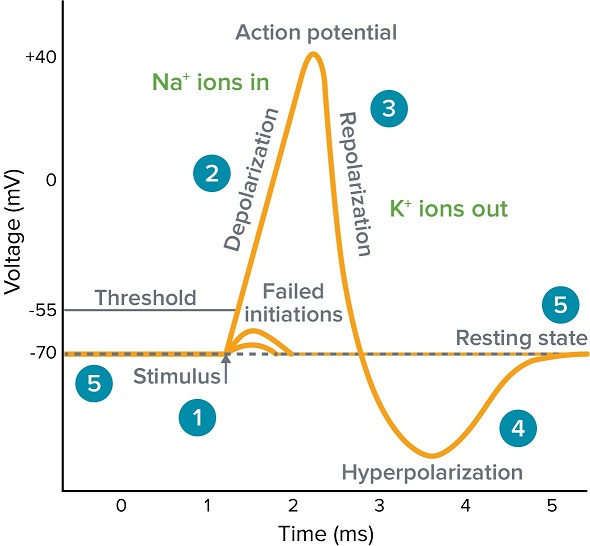
क्रिया तन्मात्र(Action Potential)

If we observe the graph of Action Potential we would understand the concept mindfulness slightly better.
This graph of Action Potential shows the response of a cell membrane when stimulated.
If we closely observe from the point of stimulus to the peak Action Potential there is an upward slope and it takes some "time" to climb up there(but its all in microseconds)
How does this relate to Mindfulness?
Well, its this climb up the slope before full Action potential is reached that buys us some "time" to reflect on our potential action.
We have the choice here as to react or not to react all in just this microsecond "spacetime"
Mindfulness is about expanding this "spacetime" as to make conducive choices.
Sometimes by observing scientific experiments we learn more about ourselves..sadly at times spirituality divorces sciences and vice versa.
Action Potential is called क्रिया तन्मात्र (kriyA tanmAtra) in Sanskrit.

Graph taken from moleculardevices website.

Action Potential Graph

  Kindly take note that all classes have been put on hold due to the recent spike of Covid 19 cases and classes would only resume if and whe...